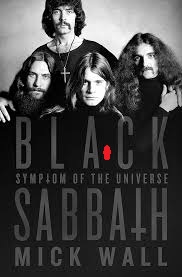


Ozzy Osbourne
Band:Black Sabbath
Genres:Heavy Metal
Born:12/03/1948
Died:07/22/2025
From: Marston Green, United Kingdom
Musician Speciality:Singer/Songwriter
Biography:
John Michael “Ozzy” Osbourne (3 December 1948 – 22 July 2025) was an English singer, songwriter and media personality. He rose to prominence during the 1970s as the lead vocalist of the heavy metal band Black Sabbath, during which period he adopted the nickname “Prince of Darkness“.[4]
Osbourne became a founding member of Black Sabbath in 1968, providing lead vocals from their eponymous debut studio album in 1970 to Never Say Die! in 1978. The band was highly influential in the development of heavy metal music, in particular their critically acclaimed releases Paranoid (1970), Master of Reality (1971), and Sabbath Bloody Sabbath (1973). Osbourne was fired from Black Sabbath in 1979 due to his problems with alcohol and other drugs. He then began a successful solo career with Blizzard of Ozz in 1980 and released 13 studio albums, the first seven of which received multi-platinum certifications in the United States. He reunited with Black Sabbath on several occasions. He rejoined in 1997 and helped record the band’s final studio album, 13 (2013), before they embarked on a farewell tour that ended with a 2017 performance in their native Birmingham.
Osbourne sold over 100 million albums, including his solo work and Black Sabbath releases.[5][6] He was inducted into the Rock and Roll Hall of Fame as a member of Black Sabbath in 2006 and as a solo artist in 2024. He was also inducted into the UK Music Hall of Fame both solo and with Black Sabbath in 2005. He was honoured with stars on the Hollywood Walk of Fame and Birmingham Walk of Stars. At the 2014 MTV Europe Music Awards, he received the Global Icon Award. In 2015, he received the Ivor Novello Award for Lifetime Achievement from the British Academy of Songwriters, Composers and Authors.
In the early 2000s, Osbourne became a reality television star when he appeared in the MTV reality show The Osbournes alongside his wife and manager Sharon and two of their children, Kelly and Jack. He co-starred with Jack and Kelly in the television series Ozzy & Jack’s World Detour as well as The Osbournes Want to Believe with his wife Sharon and son Jack.
On 5 July 2025, Osbourne performed his final show at the Back to the Beginning concert event amid ongoing health issues, having announced earlier in the year that this would be his last live performance, though he intended to continue recording music.[7] Osbourne died seventeen days later, on 22 July 2025.
Early life
John Michael Osbourne was born at Maternity Hospital in Marston Green on 3 December 1948,[8] and grew up in the Aston area of Birmingham.[9][10] His mother, Lilian (née Unitt; 1916–2001), was a non-observant Catholic who worked at a Lucas factory.[11][12][13] His father, John Thomas “Jack” Osbourne (1915–1977), worked night shifts as a toolmaker at the General Electric Company.[14][15] Osbourne had three older sisters named Jean, Iris, and Gillian, and two younger brothers named Paul and Tony.[16] The family lived in a small two-bedroom home at 14 Lodge Road in Aston. Osbourne gained the nickname “Ozzy” as a child.[17] He dealt with dyslexia at school.[18] His accent has been described as a “hesitant Brummie“.[19]
At the age of 11, he suffered sexual abuse from school bullies.[20] He said he attempted suicide multiple times as a teenager.[21][22] He participated in school plays, including Gilbert and Sullivan‘s The Mikado and HMS Pinafore.[23] Upon hearing the first hit single of the Beatles at age 14, he became a fan of the band and credited their 1963 song “She Loves You” with inspiring him to become a musician.[15][24] In the 2011 documentary God Bless Ozzy Osbourne, Osbourne said that the Beatles made him realise that “[he] was going to be a rock star the rest of [his] life”.[25]
Osbourne left school at the age of 15 and was employed as a construction site labourer, trainee plumber, apprentice toolmaker, car factory horn-tuner, and slaughterhouse worker. At the age of 17, he was convicted of robbing a clothes shop, but was unable to pay the fine; his father also refused to pay it to teach him a lesson, resulting in Osbourne spending six weeks in Winson Green Prison.[26][14]
Career
Black Sabbath
Main article: Black Sabbath
In late 1967, Geezer Butler formed his first band, Rare Breed, and recruited Osbourne to be the singer.[17] The band played two shows and broke up. Osbourne and Butler reunited in another band, Polka Tulk Blues, which included guitarist Tony Iommi and drummer Bill Ward, whose band Mythology had recently broken up. They renamed the band Earth, but after being accidentally booked for a show instead of a different band with the same name, they decided to change the band’s name again, settling on the name Black Sabbath in August 1969. The band’s name was inspired by the film of the same title.[27] Black Sabbath noticed how people enjoyed being frightened during their appearances, which inspired their decision to play a heavy blues style of music laced with gloomy sounds and lyrics.[9] While recording their first album, Butler read an occult book and woke up seeing a dark figure at the end of his bed. Butler told Osbourne about it, and together they wrote the lyrics to “Black Sabbath“, their first song in a darker vein.[28][29]
The band’s US record label, Warner Bros. Records, invested only modestly in it, but Black Sabbath met with swift and enduring success. Built around Tony Iommi’s guitar riffs, Geezer Butler’s lyrics, Bill Ward’s dark tempo drumbeats, and topped by Osbourne’s eerie vocals, their debut album Black Sabbath and Paranoid were commercially successful and also gained considerable radio airplay. Osbourne recalls, however, that, “in those days, the band wasn’t very popular with the women”.[17]
At about this time, Osbourne first met his future wife, Sharon Arden.[17] After the unexpected success of their first album, Black Sabbath were considering her father, Don Arden, as their new manager, and Sharon was at that time working as Don’s receptionist.[17] Osbourne admits he was attracted to her immediately but assumed that “she probably thought I was a lunatic”.[17] Osbourne later recalled that the best thing about eventually choosing Don Arden as manager was that he got to see Sharon regularly, though their relationship was strictly professional at that point.[17]
Just five months after the release of Paranoid, the band released Master of Reality. The album reached the top ten in both the United States and UK, and was certified gold in less than two months.[30] In the 1980s, it received platinum certification[30] and went Double Platinum in the early 21st century.[30] Reviews of the album were unfavourable. Lester Bangs of Rolling Stone famously dismissed Master of Reality as “naïve, simplistic, repetitive, absolute doggerel“, although the very same magazine would later place the album at number 298 on their 500 Greatest Albums of All Time list, compiled in 2003.[31]
In September 1972, Black Sabbath released Black Sabbath Vol. 4. Critics were dismissive of the album; however, it reached gold status in less than a month and was the band’s fourth consecutive album to sell over one million copies in the United States.[32][33]
In November 1973, Black Sabbath released the critically acclaimed Sabbath Bloody Sabbath. For the first time, the band received favourable reviews in the mainstream press. Gordon Fletcher of Rolling Stone called the album “an extraordinarily gripping affair” and “nothing less than a complete success”.[34] Decades later, AllMusic‘s Eduardo Rivadavia called the album a “masterpiece, essential to any heavy metal collection”, while also claiming the band displayed “a newfound sense of finesse and maturity”.[35] The album marked the band’s fifth consecutive platinum selling album in the US.[36] Sabotage was released in July 1975. Again there were favourable reviews. Rolling Stone stated, “Sabotage is not only Black Sabbath’s best record since Paranoid, it might be their best ever.”[37] In a retrospective review, AllMusic was less favourable, noting that “the magical chemistry that made such albums as Paranoid and Volume 4 so special was beginning to disintegrate”.[38] Technical Ecstasy, released on 25 September 1976, was also met with mixed reviews. AllMusic gives the album two stars, and notes that the band was “unravelling at an alarming rate”.[39]