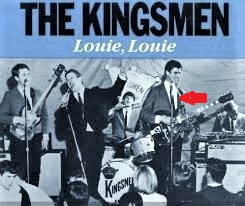


Mike Mitchell
Band:The Kingsmen
Genres:Rock, Pop
Born:04/16/1944
Died:04/16/2021
From: Portland, Oregon
Musician Speciality:Singer/Guitar
Biography:
The Kingsmen are a 1960s rock band from Portland, Oregon, United States. They are best known for their 1963 recording of R&B singer Richard Berry‘s “Louie Louie“, which held the No. 2 spot on the Billboard charts for six weeks and has become an enduring classic.
In total, the Kingsmen charted 13 singles from 1963 to 1968 and five consecutive albums from 1963 to 1966. Their first album, The Kingsmen in Person, remained on the Billboard Top LPs chart for 131 weeks from January 1964 to August 1966. Their early albums were released internationally in Canada, the UK, France, Germany, Mexico, South Africa, and Taiwan.
Early years
Lynn Easton and Jack Ely started performing at an early age in local newspaper-sponsored reviews the Journal Juniors and the Young Oregonians, respectively.[2] In 1957, they started performing together, with Ely singing and playing guitar and Easton on the drum kit. The two teenagers had grown up together, as their parents were close friends.[3] Easton and Ely performed at local parties and events, and soon added Mike Mitchell on guitar and Bob Nordby on bass to round out the band. They called themselves the Kingsmen, taking the name from a recently disbanded group.[4] The Kingsmen began their collective career playing at fashion shows, Red Cross events, and supermarket promotions, generally avoiding rock songs on their setlist.[5] In 1962, Don Gallucci, a high school freshman at the time, was recruited from another local group, the Royal Notes, to play keyboards.[6]
“Louie Louie”
In 1962, while playing a gig at the Pypo Club in Seaside, Oregon, the band noticed Rockin’ Robin Roberts‘s version of “Louie Louie” being played on the jukebox for hours on end with the entire club dancing.[7] Ely convinced the Kingsmen to learn the song, which they played at dances to a great crowd response.[8] Unknown to him, he changed the beat because he misheard it on a jukebox.[9] Ken Chase, host of radio station KISN, formed his own club to capitalize on these dance crazes.[10] Dubbed “The Chase”, the Kingsmen became the club’s house band and Ken Chase became the band’s manager. On April 5, 1963, Chase booked the band an hour-long session at the local Northwestern Inc. studio for the following day to record a demo tape for a summer cruise ship gig.[11] Adding to the hurried atmosphere, the band had just played a 90-minute “Louie Louie” marathon the night before.[12]
Despite the band’s annoyance at having so little time to prepare, on April 6 at 10 am the Kingsmen walked into the three-microphone recording studio. “Jamaica Farewell“, one partial and one full take of “Louie Louie”, and “Haunted Castle” were recorded.[13] For “Louie Louie”, the only vocal number, Ely was forced to lean back and sing to a microphone suspended from the ceiling. “It was more yelling than singing”, Ely said, “’cause I was trying to be heard over all the instruments.”[11] In addition, he was wearing braces at the time of the performance, further compounding his infamously slurred words.[14] Ely sang the beginning of the third verse two bars too early but realized his mistake and waited for the rest of the band to catch up. The Kingsmen were not proud of the recording and wanted to fix their mistakes, but Chase liked the energy and rawness[15] and assured them that the demo version could be redone before a record was released.[16] The one hour session cost either $36,[17] $50,[15] or somewhere in between [18] and the band split the cost.
With a competing “Louie Louie” version from Paul Revere and the Raiders getting heavy play on a competing station, Chase began playing the Kingsmen’s demo version on his show at KISN. He then contracted with Jerry Dennon’s Jerden Records to press a single.[19] The B-side was “Haunted Castle”, composed by Ely and Don Gallucci, the new keyboardist; however, Lynn Easton was credited on both the Jerden and Wand releases.[20]
“Louie Louie” reached No. 1 on the Cashbox and Music Vendor charts and No. 2 on the Billboard Hot 100 chart. Additionally it reached No. 1 on the CHUM Canada chart and in the UK it reached No. 26 on the Record Retailer chart. It sold over one million copies, and was awarded a gold disc.[21]
The band attracted nationwide attention when “Louie Louie” was banned by the governor of Indiana, Matthew E. Welsh, also attracting the attention of the FBI because of alleged indecent lyrics in their version of the song. The lyrics were, in fact, innocent, but Ely’s baffling enunciation permitted teenage fans and concerned parents alike to imagine the most scandalous obscenities. (Ironically, the FBI totally missed Lynn Easton yelling “Fuck!” at 0:54 after fumbling a drum fill.) All of this attention only made the song more popular. In April 1966 “Louie Louie” was reissued and once again hit the music charts, reaching No. 65 on the Cashbox chart and No. 97 on the Billboard Hot 100 chart.
In 1985, Ross Shafer, host and a writer-performer of the late-night comedy series Almost Live! on the Seattle TV station KING, spearheaded an effort to have “Louie Louie” replace “Washington, My Home” by Helen Davis as Washington‘s official state song.[22] Picking up on this initially prankish effort, Whatcom County Councilman Craig Cole introduced Resolution No. 85–12 in the state legislature, citing the need for a “contemporary theme song that can be used to engender a sense of pride and community, and in the enhancement of tourism and economic development”. His resolution also called for the creation of a new “Louie Louie County”. While the House did not pass it, the Senate’s Resolution 1985-37 declared April 12, 1985, “Louie Louie Day”. A crowd of 4,000, estimated by press reports, convened at the state capitol that day for speeches, singalongs, and performances by the Wailers, the Kingsmen, and Paul Revere and the Raiders. Two days later, a Seattle event commemorated the occasion with the premiere performance of a new, Washington-centric version of the song written by composer Berry.[23]
Over the years the Kingsmen’s version of “Louie Louie” has been recognized by organizations and publications worldwide for its influence on the history of rock and roll. Rankings and recognition in major publications and surveys are shown in the table below.