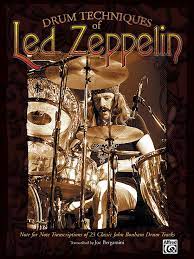


John Bonham
Band:Led Zeppelin
Genres:Hard Rock, Blues Rock
Born:05/31/1948
Died:09/25/1980
From: Redditch, United Kingdom
Musician Speciality:Drums
Biography:
John Henry Bonham (31 May 1948 – 25 September 1980) was an English musician who was the drummer of the rock band Led Zeppelin. Noted for his speed, power, fast single-footed kick drumming, distinctive sound, and feel for groove,[1] he is regarded as one of the greatest and most influential drummers in music history.[2][3][4]
Bonham was born in 1948 in Redditch, Worcestershire, and took up drums at the age of five, receiving a snare drum at the age of 10 and a full drum set at the age of 15. He played with multiple local bands both at school and following school, eventually playing in two different bands with Robert Plant. Following the demise of the Yardbirds in 1968, Bonham joined Plant, guitarist Jimmy Page and bass guitarist John Paul Jones to form Led Zeppelin. With the band, Bonham mostly showcased a hard-hitting hard rock style, but also handled funk and Latin-influenced grooves in later releases. Like Keith Moon of the Who, Bonham’s drum set grew in size following the band’s 1969 concert tours, including congas or timpani and a gong. His drum solo “Moby Dick” was featured on the group’s second album and was a staple of their concerts, often lasting over 20 minutes. Outside of Led Zeppelin, Bonham played drums for other artists, including the Family Dogg, Screaming Lord Sutch, Lulu, Jimmy Stevens and Wings. Bonham played with Led Zeppelin until his death at the age of 32, in September 1980 following a day of heavy drinking. The surviving members disbanded the group out of respect for Bonham after his death.
A mostly self-taught drummer, Bonham was influenced by Max Roach, Gene Krupa and Buddy Rich. He was close with Vanilla Fudge drummer Carmine Appice, who introduced him to Ludwig drums. While he was primarily known for his hard-rock style during his lifetime, his reputation as a drummer has grown beyond that genre following his death. He has influenced various drummers, with just a few prominent examples including Dave Grohl, Neil Peart, Chad Smith and Dave Lombardo. He was posthumously inducted into the Rock and Roll Hall of Fame in 1995 as a member of Led Zeppelin. In 2016, Rolling Stone named him the greatest drummer of all time.[5]
Biography
Early years
John Henry Bonham was born on 31 May 1948, in Redditch, Worcestershire, England, to Joan and Jack Bonham. He began learning to play drums at age five, making a kit of containers and coffee tins, imitating his idols Max Roach, Gene Krupa, and Buddy Rich. His mother gave him a snare drum when he was 10. He received his first drum kit, a Premier Percussion set, from his father at age 15. Bonham never took formal drum lessons, although he received advice from other Redditch drummers. While at school, between 1962 and 1963, Bonham joined the Blue Star Trio[6] and Gerry Levene & the Avengers.[7]
Bonham attended Lodge Farm Secondary Modern School, where his headmaster wrote in his report that he would “either end up a dustman or a millionaire.”[8][9] After leaving school in 1964, he worked for his father as an apprentice carpenter[10] between drumming for local bands. In 1964, Bonham joined his first semi-professional band, Terry Webb and the Spiders, and met his future wife, Pat Phillips, around the same time. He played in other Birmingham bands such as The Nicky James Movement and The Senators, with whom he made a single, “She’s a Mod“, in 1964, at Hollick and Taylor Studios in Birmingham.[11] Bonham took up drumming full-time. Two years later, he joined A Way of Life. After the band’s demise, Bonham joined a blues group called Crawling King Snakes, whose lead singer was Robert Plant.[12]
In 1967, Bonham agreed to return to A Way of Life while keeping in touch with Plant. Plant formed Band of Joy and chose Bonham as the drummer. The band recorded demos but no album. In 1968, American singer Tim Rose toured Britain and asked Band of Joy to open his concerts. When Rose returned months later, Bonham joined Rose’s band.[12]
Bonham may have played on the April 1968 recording of Donovan‘s “Hurdy Gurdy Man” although this is disputed, as discussed in the article for the song.
Led Zeppelin
After the breakup of the Yardbirds in July 1968, guitarist Jimmy Page formed another band and recruited Plant, who in turn suggested Bonham.[13] Page’s choices for drummer included Procol Harum‘s B.J. Wilson and Paul Francis.[14] However, on seeing Bonham drum for Tim Rose at a club in Hampstead, north London, in July 1968, Page and manager Peter Grant were convinced he was perfect for the project, first known as the New Yardbirds and later as Led Zeppelin.[15] Bonham was initially reluctant. Plant sent eight telegrams to Bonham’s pub, the “Three Men in a Boat”, in Walsall, which were followed by 40 telegrams from Grant. Bonham was also receiving more lucrative offers from Joe Cocker and Chris Farlowe but he accepted Grant’s offer. He recalled, “I decided I liked their music better than Cocker’s or Farlowe’s.”[16][17]
During Led Zeppelin’s first tour of the United States in December 1968, Bonham became friends with Vanilla Fudge‘s drummer, Carmine Appice. Appice introduced him to Ludwig drums, which he then used for the rest of his career.[18] His hard hitting was evident on many Led Zeppelin songs, including “Moby Dick” (Led Zeppelin II), “Immigrant Song” (Led Zeppelin III), “When the Levee Breaks” (Led Zeppelin IV), “Kashmir” (Physical Graffiti), “The Ocean” (Houses of the Holy), and “Achilles Last Stand” (Presence). Page let Bonham use a double bass drum in an early demo of “Communication Breakdown” but scratched the track because of Bonham’s “over-use” of it. The studio recording of “Misty Mountain Hop” captures his dynamics, similarly exhibited on “No Quarter“.[19] On cuts from later albums, Bonham handled funk and Latin-influenced drumming. Songs like “Royal Orleans” and “Fool in the Rain” are examples, respectively displaying a New Orleans shuffle and a half-time shuffle.[20]
His drum solo, first entitled “Pat’s Delight”, later “Moby Dick“, often lasted 20 minutes. In some sections, he used his bare hands on his drums to imitate the sound of a phased hand drum.[21] Bonham’s sequence for the film The Song Remains the Same featured him in a drag race at Santa Pod Raceway to the sound of his solo, “Moby Dick”.[22] In Led Zeppelin tours after 1969, Bonham included congas, orchestral timpani and a symphonic gong.[21]