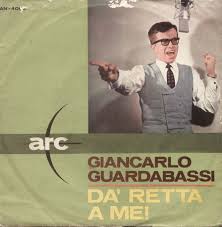


Giancarlo Guardabassi
Band:Radio Rai
Genres:Pop
Born:08/21/1937
Died:07/17/2024
From: Foligno, Italy
Musician Speciality:Singer/Radio DJ
Biography:
Giancarlo Guardabassi ( Foligno , 21 August 1937 – Francavilla d’Ete , 17 July 2024 [1] ) was an Italian disc jockey , singer , lyricist and radio host .
Son of Count Alberto Guardabassi (a local doctor) and Baroness Orietta Danzetta, Giancarlo Guardabassi came from an ancient family from Perugia (in Perugia , he lived right in via Guardabassi, so called in honour of his ancestor, Senator Francesco Guardabassi , a hero of the Risorgimento from the Umbrian capital).
In the 1950s he attended the classical high school in via Guardabassi in Perugia and subsequently graduated in Law at the University of Perugia , where he initially began his legal career at a well-known law firm.
In November 1958 he won the Edera d’Oro National Light Music Competition in Collescipoli [2] .
Singer
In the first half of the 1960s Guardabassi was introduced to the talent scout and author Franco Migliacci by his friend and pianist from Perugia Claudio Mantovani. In Migliacci’s Roman home, Guardabassi auditioned with success. Migliacci and Mantovani then brought Guardabassi to the court of the musician Bruno Zambrini and Guardabassi’s musical career began. Se ti senti sola , a song he presented at the Cantagiro in 1964, reached the top of the Italian sales charts. Among his other successes were Sulamente a mia , a song with which he participated in the 1964 Naples Festival in a duet with Claudio Villa , Da’ retta a me , A me piace tua figlia .
Guardabassi also recorded some hits in Spanish and after a tour in Argentina and Brazil his songs were broadcast on the radio in South and Central America, where he became particularly well-known in Argentina and Cuba. On the Caribbean island, in what was called the “decada prodigiosa”, Giancarlo Guardabassi was introduced on the radio with his real name or preferably with the adapted name of Juan Carlos Guardaban.
Giancarlo Guardabassi also became a lyricist, writing songs for some of the most popular singers of the time. Among his best-known songs, Se puoi andare una domenica sola con me for Gianni Morandi , Pietà per chi ti ama , No mamma , Ma l’amore cos’è , Cento Ragazzine , Preghiera per lei and Cielo blu for Massimo Ranieri , Mulino a vento for Little Tony , Casatschok performed by Dori Ghezzi , Il duca della Luna for Mariolino Barberis and arranged by Ennio Morricone , Non m’importa più sung by Donatella Moretti , Povero cuore sung by Claudio Villa , Un atto di dolore sung by Peppino Gagliardi , Il ballo di Peppe performed by the group I Cugini di Campagna , L’amore dice ciao performed by Andee Silver for the soundtrack of the film by Pasquale Festa Campanile La matriarca , with music by Armando Trovajoli , Principe azzurro for Cristy (with music by Carlo Pes ). Guardabassi wrote and signed the songs with his own name and sometimes with the pseudonym Anassandro.
In 1971 Giancarlo Guardabassi was the creator of a show entirely dedicated to Gigliola Cinquetti entitled “Ma l’amore sì”, directed by Maurizio Corgnati.
In 1975 Guardabassi wrote the lyrics for the live show Concerto d’estate – Dal vivo dalla Bussola , in which Marcella Bella , Sandro Giacobbe , Gigliola Cinquetti , Loredana Bertè , Al Bano and Romina Power took part and from which an album was made which enjoyed a certain success.
Giancarlo Guardabassi had various experiences as a television writer, between 1971 and 1976, for programs broadcast on the two Rai channels existing at the time.
In the 1960s Giancarlo Guardabassi began his career as a radio disc jockey on Radio Rai, hosting important music programmes such as Countdown together with Anna Carini , during which he presented previews of songs that had never arrived in Italy and which became a point of reference for the young people of the time; Gli amici della settimana , with the best songs of the week and directed by Maurizio Costanzo ; Il mattiniere , broadcast in 1968 starting at 6 in the morning, which became a point of reference for the awakening of Italians, hosted together with Federica Taddei and Adriano Mazzoletti and during which the latest Italian and foreign musical novelties were proposed; Discosfida [3] , in which Guardabassi conducted the first interview in the career of Vasco Rossi , who presented his debut album Ma cosa vuoi che sia una canzone ; Dischi caldo , the most successful programme by Guardabassi, who was also the author of the broadcast, directed by Enzo Lamioni , a true cult programme in the history of radio in Italy.
The first episode of Dischi caldi was broadcast on 7 October 1973 on Radio 1. Guardabassi was the author and host of this programme. During the programme, the songs placed from ninth to sixteenth place in the Italian sales charts were proposed. The dischi caldo were in fact the records that were warming up, ready to enter the Hit Parade of Lelio Luttazzi , a programme that Guardabassi himself hosted for a short period. Guardabassi’s cry “Forza Perugiaaa” [4] became known to Italians to the point that Ilario Castagner , the then coach of the Perugia football team of president Franco D’Attoma , publicly thanked the host [5] during the promotion party in Piazza IV Novembre in the presence of a large crowd of fans, because he encouraged the team before taking to the field. Phrases like ” From the youngest to the oldest: everyone listen to the hearing aid! ” or ” Tebaldi doesn’t sing them but they are very very very hot “, figures like ” the Griffin of Annifo ” and ” the Cozza of Trasimeno ” entered the imagination of listeners of the time.
Guardabassi also made the town of Francavilla d’Ete and its most typical characters of the time famous. Francavilla was a little-known town of about a thousand inhabitants in the province of Fermo , of which Guardabassi sang the praises, told anecdotes and where he cultivated interests, becoming the place where he founded his current business.
Dischi caldo was interrupted in 1976, as was the contemporary program Hit Parade hosted by Lelio Luttazzi , which Guardabassi had replaced for a short period in June 1970, when Luttazzi was arrested, together with his friend and actor Walter Chiari , on charges of possession and dealing of drugs. The judicial affair saw Luttazzi completely exonerated from the accusation and extraneous to the facts.
The Dischi caldi broadcast was interrupted at its peak, when it was followed by an average of approximately 6 million listeners per day.
Some critics have considered Giancarlo Guardabassi a precursor [6] of many modern radio hosts, a forerunner of that lively and American disc-jockey style that from then on would also be adopted by the nascent private broadcasters and by many of its interpreters. A fast pace, rapid sketches with fictional characters always played by Guardabassi, such as the popular Perugian Peppin de Sguilla and above all as his alter ego Giambasso , with whom he interacted in a rapid overlapping of voices, with a rapid and personal style, have made Dischi caldo an important and innovative programme in the national radio panorama.
Even in Dischi caldo , as in Lelio Luttazzi ‘s “Hit Parade” , there was a tendency to speak over the song in progress to name its title and performer, avoiding overlapping with the sung parts and exploiting only the musical pauses.
Giancarlo Guardabassi can be considered one of the first Italian disc jockeys , thanks to his youthful and modern style.
In 1976 , riding the wave of radio success, Giancarlo Guardabassi was chosen by patron Vittorio Salvetti to present the 26th edition of the Sanremo Festival , in order to relaunch the event, which had seen its worst year in 1975. The choice fell on Guardabassi after Domenico Modugno , initially designated to host, withdrew for personal reasons a few days before the event. Guardabassi was forced to prepare the festival in just a few days. Domenico Modugno then appeared on the final night as the main guest and performed live, playing a medley of his hits on the guitar.
This was the last edition of the Festival broadcast in black and white on television. The Festival was organized in three evenings, on February 20, 21 and 22. For the first time in the history of the Festival the host never went on stage, but always remained seated at a table at the foot of the stage itself, with his back to a column and facing the scene: Guardabassi hosted the broadcast as if he were on the radio, never looking at the camera, flanked by two different assistants for each of the three evenings, who never spoke. The hosting was in a modern style, typical of American DJs, from whom he was inspired.
The evenings of the 20th and 21st were broadcast on the second program of Radio Nazionale. The video recording of the final evening of the Festival, the only one to be broadcast live on the National channel at 8:30 pm, was lost in a fire in the Rai archives in Turin. Only a few versions exist, broadcast by foreign televisions and in color, thanks to Mondovisione Rai, with the commentary of the simultaneous translator in Spanish. This edition of the Festival was won by Peppino Di Capri .
On 1 August 1976 Giancarlo Guardabassi founded Radio Aut Marche together with his friend Goffredo Luciani , a private radio station of which he was editor, director, host and disc jockey .
On 5 July 2006 Radio Aut Marche received an award from Aeranti Corallo, an association of private radio and television broadcasters [7] .
The radio’s activities were effectively suspended at the end of 2019, with the closure of live broadcasts.
Guardabassi lives in Francavilla d’Ete , having retired to private life.
He died in Francavilla d’Ete, where his historic radio was based, on July 17, 2024.
From the late seventies to the late nineties, Giancarlo Guardabassi toured Italy with his “GG Show”. The show, different every year, was presented in a square; Guardabassi hosted the show accompanied by a musical orchestra and singers, dancers and comedians. In the last editions, a young Neri Marcorè [8] participated in the show as a singer and imitator.