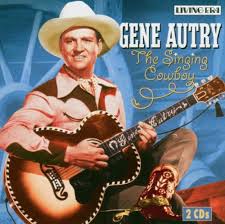


Gene Autry
Band:Nashville Songwriters Hall of Fame
Genres:Western, Country
Born:09/29/1907
Died:10/02/1998
From: Tioga, Texas
Musician Speciality:Singer/Guitar/Actor
Biography:
Orvon Grover “Gene” Autry[1] (September 29, 1907 – October 2, 1998),[2] nicknamed the Singing Cowboy, was an American actor, musician, singer, composer, rodeo performer, and baseball owner who gained fame largely by singing in a crooning style on radio, in films, and on television for more than three decades beginning in the early 1930s. Autry was the owner of a television station and several radio stations in Southern California. He was the founding owner of the California Angels[Note 1] franchise of Major League Baseball (MLB) from 1961 to 1997.
From 1934 to 1953, Autry appeared in 93 films, and between 1950 and 1956 hosted The Gene Autry Show television series. During the 1930s and 1940s, he personified the straight-shooting hero—honest, brave, and true.[3] Autry was also one of the most important pioneering figures in the history of country music, considered the second major influential artist of the genre’s development after Jimmie Rodgers.[3] His singing cowboy films were the first vehicle to carry country music to a national audience.[3] In addition to his signature song, “Back in the Saddle Again” and his hit “At Mail Call Today“, Autry is still remembered for his Christmas songs, most especially his biggest hit “Rudolph, the Red-Nosed Reindeer” as well as “Frosty the Snowman“, “Here Comes Santa Claus“, and “Up on the House Top“.
Autry is a member of both the Country Music Hall of Fame and the Nashville Songwriters Hall of Fame, and is the only person to be awarded stars in all five categories on the Hollywood Walk of Fame, for film, television, music, radio, and live performance.[4] The town of Gene Autry, Oklahoma, was named in his honor, as was the Gene Autry precinct in Mesa, Arizona.[5]
Life and career
Early years
Orvon Grover Autry was born September 29, 1907, near Tioga in Grayson County in north Texas,[6] the grandson of a Methodist preacher. His parents, Delbert Autry and Elnora Ozment, moved in the 1920s to Ravia in Johnston County in southern Oklahoma. Gene Autry worked on his father’s ranch while growing up and going to school. In 1925, Autry left the family ranch. With only his high school education, Autry became a telegrapher[7] for the St. Louis–San Francisco Railway. His talent at singing and playing guitar led to performing at local dances.
Singing career
While working as a telegraph operator in Chelsea, Oklahoma, Autry would sing and accompany himself on the guitar to pass the lonely hours, especially when he had the midnight shift. This later got him fired. One night, he was encouraged to sing professionally by a customer, humorist Will Rogers, who had heard him singing.[8][9][10]
As soon as he could save money to travel, he went to New York. In the autumn of 1928, he auditioned for the Victor Talking Machine Company, shortly before purchase by David Sarnoff‘s Radio Corporation of America (RCA). According to Nathaniel Shilkret,[11] director of Light Music for Victor at the time, Autry asked to speak to Shilkret after finding that he had been turned down. Shilkret explained to Autry that he was turned down not because of his voice, but because Victor had just made contracts with two similar singers. Autry left with a letter of introduction from Shilkret and the advice to sing on radio to gain experience and to come back in a year or two. In 1928, Autry was singing on Tulsa radio station KVOO (now KTSB) as “Oklahoma’s Yodeling Cowboy”. The Victor archives[12] show an October 9, 1929, entry stating that the vocal duet of Jimmie Long and Gene Autry with two Hawaiian guitars, directed by L. L. Watson, recorded “My Dreaming of You” (Matrix 56761) and “My Alabama Home” (Matrix 56762).
Autry signed a recording deal with Columbia Records in 1929. He worked in Chicago on the WLS-AM radio show National Barn Dance for four years, and with his own show, where he met singer-songwriter Smiley Burnette. In his early recording career, Autry covered various genres, including a labor song, “The Death of Mother Jones“, in 1931.
Autry also recorded many “hillbilly“-style records in 1930 and 1931 in New York City, which were certainly different in style and content from his later recordings. These were much closer in style to the Prairie Ramblers or Dick Justice, and included the “Do Right, Daddy Blues” and “Black Bottom Blues”, both similar to “Deep Elem Blues“. These late Prohibition-era songs deal with bootlegging, corrupt police, and women whose occupation was certainly vice. These recordings are generally not heard today, but are available on European import labels, such as JSP Records. His first hit was in 1932 with “That Silver-Haired Daddy of Mine“, a duet with fellow railroad man Jimmy Long that Autry and Long co-wrote.
As Autry’s movie career flourished, so did his record sales. His unofficial theme song became the Ray Whitley composition “Back in the Saddle Again“.[13] Autry made 640 recordings, including more than 300 songs written or co-written by himself. His records sold more than 100 million copies and he has more than a dozen gold and platinum records, including the first record ever certified gold.
Today’s listeners associate Gene Autry with Christmas songs, which are played perennially during each holiday season. These include “Santa Claus Is Comin’ to Town“, his own composition “Here Comes Santa Claus“, “Frosty the Snowman“, and his biggest hit, “Rudolph, the Red-Nosed Reindeer“. He wrote “Here Comes Santa Claus” after being the Grand Marshal of the 1946 Santa Claus Lane Parade (now the Hollywood Christmas Parade). He heard all of the spectators watching the parade saying, “Here comes Santa Claus!” virtually handing him the title for his song. He recorded his version of the song in 1947 and it became an instant classic.
In the late 1950s he began recording other artists, as the original owner of Challenge Records. The label’s biggest hit was “Tequila” by The Champs in 1958, which started the rock and roll instrumental craze of the late 1950s and early 1960s. He sold the label soon after, but the maroon (later green) label has the “GA” in a shield above the label name.