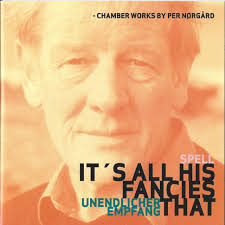


Per Nørgård
Band:Adolf Wölfli
Genres:Symphony
Born:07/13/1932
Died:05/28/2025
From: Gentofte, Denmark
Musician Speciality:Composer/Music Theorist
Biography:
Per Nørgård (pronounced [ˈpʰɛɐ̯ ˈnɶɐ̯ˌkɒˀ]; 13 July 1932 – 28 May 2025) was a Danish composer and music theorist. Though his style varied considerably throughout his career, his music often included repeatedly evolving melodies—such as the infinity series—in the vein of Jean Sibelius, and a perspicuous focus on lyricism.[1] Reflecting on this, the composer Julian Anderson described his style as “one of the most personal in contemporary music“.[1] Nørgård received several awards, including the 2016 Ernst von Siemens Music Prize.
Life and career
Per Nørgård was born in Gentofte, Denmark on 13 July 1932.[2] He studied with Vagn Holmboe privately at age 17,[2] and then formally at Royal Danish Academy of Music, Copenhagen,[3] with Holmboe, Harald Høffding[4] and Herman David Koppel.[5] From 1956 to 1957, he subsequently studied in Paris with Nadia Boulanger, who had taught many leading composers of the time.[2] Nørgård soon gained his own teaching positions, first at the Odense Conservatory in 1958, and then at the Royal Danish Conservatory of Music in 1960.[6][7] His students at the latter included the composer Carl Davis.[8] Between 1958 and 1962, Nørgård had a stint as a music critic for the newspaper Politiken.[7] He left these positions to teach composition at the Royal Academy of Music, Aarhus/Aalborg in 1965.[6] Here he taught many composers who would go on to have major careers, including Hans Abrahamsen,[6] Hans Gefors,[9] Karl Aage Rasmussen,[6] Bent Sørensen,[6]
To begin with, he was strongly influenced by the Nordic styles of Jean Sibelius, Carl Nielsen and Vagn Holmboe. In the 1960s, Nørgård began exploring the modernist techniques of central Europe, eventually developing a serial compositional system based on the “infinity series”,[10] which he used in his Voyage into the Golden Screen, the Second and Third Symphonies, I Ching, and other works of the late 1960s and 70s.[11] Later he became interested in the Swiss artist Adolf Wölfli, who inspired many of Nørgård’s works, including the Fourth Symphony, the opera Det Guddommelige Tivoli and Papalagi for solo guitar.[12]
Nørgård composed works in all major genres: six operas, two ballets, eight symphonies and other pieces for orchestra, several concertos, choral and vocal works, a very large number of chamber works (among them ten string quartets) and several solo instrumental works. These include a number of works for the guitar, mostly written for the Danish guitarist Erling Møldrup: In Memory Of… (1978), Papalagi (1981), a series of suites called Tales from a Hand (1985–2001), Early Morn (1997–98) and Rondino Amorino (1999). One of his most important works for percussion solo is I Ching (1982) for the Danish percussionist Gert Mortensen. He has also composed music for several films, including The Red Cloak (1966), Babette’s Feast (1987), and Hamlet, Prince of Denmark (1993).[13]
His eighth symphony was premiered on 19 September 2012 in the Helsinki Music Centre, Finland, by the Helsinki Philharmonic Orchestra conducted by John Storgårds.[14] Heikki Valska from the Finnish radio described the symphony as “very bright and lyrical” and “approachable”. It was well received by the audience at the premiere.[15] It was later recorded by the Vienna Philharmonic Orchestra conducted by Sakari Oramo.[16]
Nørgård was also a prolific writer. He wrote many articles dealing with music not only from a technical but also a philosophical viewpoint.[17]
Nørgård died on 28 May 2025 in Copenhagen, at the age of 92.[18][19][20]