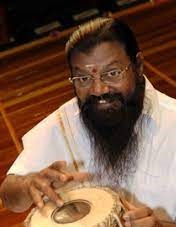


Karaikudi Mani
Band:Sruthi Laya
Genres:Carnatic Music
Born:09/11/1945
Died:05/04/2023
From: Karaikudi, India
Musician Speciality:Mridangam Player
Biography:
Karaikudi Mani (born Ganapathy Subramanyam; 11 September 1945 – 4 May 2023) was an Indian mridangam player.[1]
Early life
Karaikudi Mani was born on 11 September 1945 in Karaikudi, Tamil Nadu. He was the son of T. Ramanatha Iyer and Pattammal. He became involved with Carnatic music at the age of three and soon abandoned his vocal training in favour of learning the mridangam.[2]
Career
Mani began performing regularly at a time when another player of the mridangam, his idol Palghat Mani Iyer, was in his prime. He took further lessons under the tutelage of Harihara Sharma after moving to Chennai, and received his first national award at age 18 from the then president of India, Radhakrishnan. In a 2015 interview he claimed that receiving awards and titles had never been part of his agenda. In 1999 he accepted the national award from “Sangeeth Natak Academy”. This was presented by the president of India at that time, K. R. Narayanan.
Sruthi Laya
In 1986, he started an ensemble, Sruthi Laya, that combined melody and percussion.[3] Three years later, he founded the Sruthi Laya Seva School that now has centres at Chennai, Bangalore, Australia, London, US, and Canada.
Thani Avarthanam – A Concept
Mani conducted and orchestrated several such concerts, notably a collaboration with Sri VS Narasimhan in 1990 called Melodyssey, a project with 40 artists, and including Western and Indian Instruments.
His next endeavour was the concept of “Thani Avarthanam” concerts. Whilst Thala Vadya (percussion ensemble) concerts in Carnatic music were not unheard of, the concept of just two percussion instruments performing solos without any other “sruthi” performers (e.g. vocal, violin) had never been attempted. In 1993, Karaikudi Mani presented his first Thani Avarthanam concert along with the late Kanjira player G Harishankar. It had revolutionised the role of the mridangam, proving that as an art form, South Indian percussion instruments can be played as solo instruments in their own right. This concept initiated by Mani has since been undertaken by several leading mridangists who have also performed Thani Avarthanam concerts.Mani later conducted several such duet concerts featuring leading percussionists on Ghatam, Thavil, Chendai, etc.
International collaborations
Mani had performed with many international artists such as Paul Grabowsky of Australian Art Orchestra, Eero Haemmeneimi of Finland Naada group,[4] La Scala percussionist Elio Marchesini, Livio Magnini, Paul Simon, and with the Finland Philharmonic Orchestra. A piece called Layapriya was performed with the Finland Philharmonic Orchestra,[5] which was later performed by the Battery Dance Company as a dance ballet. The Australian Art Orchestra had adapted his Bahudari and Ranjani compositions into Jazz style and released it as Into The Fire. The Naada group of Finland modified the Behag composition with jazz orchestration and released it as Unmatched. Eero Haemmeneimi dedicated four compositions to Mani.
He had also collaborated with Japanese musician John Kaizan Neptune to create an album named Steps in Time.[6] In this album, Mani had created a synthesis of shakuhachi and Indian percussion.
In 2008, Mani collaborated with Sarangan Sriranganathan and other Australian musicians in a classical fusion concert called Unity in Diversity.
In 2011, he played on Paul Simon’s album So Beautiful or So What.
Mani founded a magazine called Layamani Layam.[7]